
The decision between full-time and part-time employment is a pivotal one, impacting not only income but also work-life balance, career trajectory, and overall well-being. This exploration delves into the multifaceted considerations involved in choosing between these two distinct employment paths, examining the financial implications, lifestyle adjustments, and long-term career prospects each offers.
From analyzing average salary discrepancies across various industries to dissecting the nuances of benefits packages and work-life integration, we aim to provide a comprehensive overview that empowers individuals to make informed decisions aligned with their personal and professional aspirations. We’ll consider the evolving landscape of modern work and the increasing prevalence of flexible arrangements, offering insights for individuals navigating the complexities of today’s job market.
Income and Financial Stability
The choice between full-time and part-time employment significantly impacts an individual’s financial well-being. This section explores the income differences, financial implications, and the effects of income variability on financial planning for both employment types. Understanding these factors is crucial for making informed career decisions.
Average Income Levels Across Industries
The disparity in income between full-time and part-time positions varies considerably across different industries. Generally, full-time roles offer significantly higher annual earnings due to the increased number of working hours. However, even within the same industry, part-time positions can sometimes offer surprisingly competitive hourly rates, though the overall annual income remains lower. The following table provides a comparative overview, acknowledging that these figures represent averages and can fluctuate based on experience, location, and company size.
Note that these figures are illustrative and based on generalized data; precise figures will vary widely depending on location and specific job roles.
| Industry | Average Full-Time Annual Salary | Average Part-Time Hourly Rate | Average Part-Time Annual Income (20 hours/week) |
|---|---|---|---|
| Technology | $100,000 | $35 | $36,400 |
| Healthcare | $65,000 | $20 | $20,800 |
| Retail | $30,000 | $15 | $15,600 |
| Education | $50,000 | $18 | $18,720 |
Financial Implications of Full-Time and Part-Time Employment
Full-time employment typically comes with a comprehensive benefits package, including health insurance, retirement plans (like 401(k)s), paid time off, and sometimes even tuition reimbursement. These benefits significantly reduce an employee’s overall financial burden. Part-time positions often offer fewer, if any, benefits, increasing the financial responsibility on the employee. Taxes also play a significant role. While the tax rate is generally progressive (higher earners pay a higher percentage), full-time employees, due to their higher income, often pay more in taxes than part-time employees.
However, this also means they may have a higher tax return or greater access to tax-advantaged savings plans. Savings potential is directly related to income. Full-time employees generally have a higher capacity for saving and investing due to their greater disposable income.
Impact of Income Variability on Financial Planning
Income variability significantly impacts financial planning. Full-time employment provides more predictable income streams, facilitating easier budgeting and long-term financial planning. This stability allows for consistent contributions to savings, investments, and debt repayment. Part-time work, often characterized by fluctuating hours or seasonal employment, presents greater challenges in financial planning. Budgeting becomes more complex, and unexpected expenses can severely impact financial stability.
For example, a part-time employee relying on seasonal work might struggle to maintain consistent savings during the off-season, potentially requiring them to utilize savings or incur debt to cover living expenses. Effective financial planning for part-time employees requires a higher degree of flexibility and contingency planning, potentially including establishing an emergency fund to cushion against periods of reduced income.
Work-Life Balance
Achieving a healthy work-life balance is a crucial aspect of overall well-being, and the type of employment – full-time or part-time – significantly influences this balance. Understanding the typical schedules and flexibility associated with each can help individuals make informed decisions aligned with their personal needs and priorities.The flexibility and scheduling differences between full-time and part-time work dramatically impact an individual’s ability to manage their personal life alongside their professional responsibilities.
This impact varies depending on individual circumstances, such as parental responsibilities, academic pursuits, or other commitments.
Full-Time and Part-Time Work Schedules and Flexibility
Full-time employment generally involves a consistent, often demanding, schedule, typically 35-40 hours per week, often with set working days and hours. Part-time work, conversely, offers greater flexibility with fewer working hours, potentially allowing for more adaptable schedules.
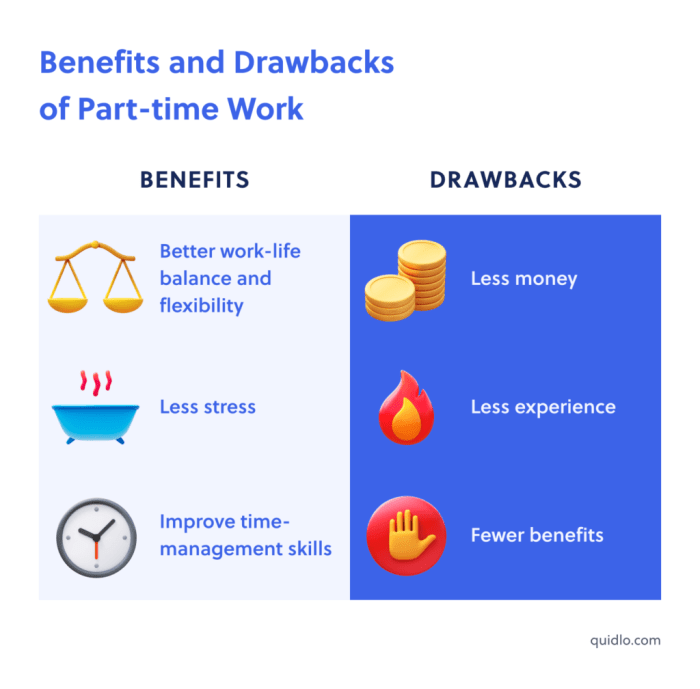
- Full-Time Pros: Consistent income, potential for career advancement, employer-provided benefits (health insurance, retirement plans).
- Full-Time Cons: Less flexibility, potential for burnout, limited time for personal pursuits.
- Part-Time Pros: Greater flexibility, better work-life balance, potential to pursue other interests or commitments.
- Part-Time Cons: Lower income, potentially fewer benefits, limited career advancement opportunities.
Work-Life Balance for Different Groups
The impact of full-time versus part-time work on work-life balance varies greatly depending on individual circumstances. Parents: Full-time employment can present significant challenges for parents, especially those with young children, requiring extensive childcare arrangements. Part-time work can offer more flexibility to manage childcare responsibilities and school schedules, potentially reducing stress and enhancing family time. For example, a part-time teacher might be able to adjust their hours to align with school holidays, allowing for more time with their children.
A full-time lawyer, however, may find it difficult to attend school events or handle unexpected childcare issues due to inflexible work hours. Students: Part-time work is often ideal for students, allowing them to earn income while pursuing their education. Full-time employment can be overwhelming, potentially hindering academic performance and overall well-being. A student working part-time in a retail setting might be able to manage their shifts around their class schedule, whereas a full-time job might necessitate sacrificing academic pursuits.
Individuals with Other Commitments: Individuals with significant caregiving responsibilities (elderly parents, disabled family members) or volunteer commitments often find part-time work more manageable. The flexibility allows them to balance their work obligations with their personal responsibilities without sacrificing either. A full-time nurse caring for an elderly parent might struggle to meet both demands, while a part-time social worker may find the schedule more accommodating.
Hypothetical Scenario: Balancing Personal Life with Work
Sarah, a single mother, needs to balance work and raising her young child. In a full-time role as a marketing manager, Sarah faces long hours and limited flexibility. She struggles to find reliable and affordable childcare, often feeling overwhelmed and stressed. Her evenings and weekends are consumed with work and childcare, leaving little time for personal pursuits or relaxation.Conversely, imagine Sarah in a part-time role as a freelance writer.
She has more control over her schedule, allowing her to work around her child’s needs. She can arrange her work hours to accommodate school pick-ups and appointments, reducing stress and improving her work-life balance. While her income is lower, she experiences less stress and enjoys more quality time with her child. This improved well-being, in the long run, may contribute positively to her overall productivity and career trajectory.
Career Progression and Opportunities
The choice between full-time and part-time employment significantly impacts career trajectory. While both offer avenues for professional growth, the pace and potential differ considerably, influenced by factors like company culture, industry norms, and individual ambition. Understanding these differences is crucial for making informed career decisions.Full-time roles generally provide more structured pathways for advancement. Increased visibility, greater responsibility, and more opportunities for mentorship often lead to quicker promotions and salary increases.
Part-time positions, conversely, may offer less direct access to these opportunities, though this isn’t universally true.
Full-Time Employment and Career Advancement
Full-time employees typically have more opportunities for career progression. They are often more visible to management, leading to greater consideration for promotions and leadership roles. Moreover, they have more time to dedicate to company projects, training, and networking, which are all crucial for climbing the corporate ladder. For instance, a full-time marketing assistant might have the opportunity to manage entire campaigns, leading to a promotion to Marketing Manager, while a part-time assistant might only manage smaller components of a campaign.
This difference in responsibility and experience directly impacts future career prospects.
Part-Time Employment as a Stepping Stone
Part-time work can serve as a valuable stepping stone to full-time employment. It allows individuals to gain experience in a specific field, build their skills, and establish a professional network within a company or industry. A successful part-time employee may be offered a full-time position based on their performance and contributions. For example, an individual might work part-time as a software developer, demonstrating their skills and dedication.
This could lead to a full-time offer once a permanent position opens. Similarly, internships, often part-time, provide crucial experience and connections that greatly enhance future job prospects.
Limitations and Advantages of Each Employment Type
Full-time employment, while offering faster career advancement, can limit work-life balance and potentially lead to burnout. The constant pressure to perform and meet deadlines can negatively impact personal well-being. Part-time work, on the other hand, may limit career progression due to reduced visibility and fewer opportunities for responsibility. However, it offers greater flexibility and a better work-life balance, which can be particularly beneficial for individuals with family responsibilities or other commitments.
For instance, a parent might choose part-time work to balance childcare and career aspirations, accepting a slower career progression for a more fulfilling life outside of work. Ultimately, the optimal choice depends on individual priorities and career goals.
Benefits and Employee Packages
The availability and comprehensiveness of employee benefits packages often significantly differentiate full-time and part-time employment. Understanding these differences is crucial for individuals weighing the pros and cons of each employment type, as benefits directly impact financial security, overall well-being, and job satisfaction. This section will compare typical benefits offered to full-time and part-time employees, highlighting the potential implications for employee morale and retention.
Comparison of Full-Time and Part-Time Employee Benefits
The following table provides a comparison of common benefits packages offered to full-time and part-time employees. It’s important to note that these are general observations and specific benefits can vary widely depending on the employer, industry, and location. Individual contracts should always be consulted for precise details.
| Benefit | Full-Time Employee | Part-Time Employee | Notes |
|---|---|---|---|
| Health Insurance | Often offered as a comprehensive group plan, often with employer contributions. | May be offered, but often at a higher cost to the employee, with less comprehensive coverage, or not offered at all. | Eligibility often depends on hours worked per week. |
| Paid Time Off (PTO) | Typically includes vacation, sick leave, and potentially paid holidays. Accrual rates vary. | May receive limited or no paid time off, possibly only for sick leave, and often with lower accrual rates or limited eligibility. | Accrual rates are frequently proportional to hours worked. |
| Retirement Plans | Usually offered with employer matching contributions (e.g., 401(k) plans). | May not be offered, or participation may be limited, often without employer matching contributions. | Eligibility often depends on hours worked and tenure. |
| Other Benefits | May include life insurance, disability insurance, employee assistance programs (EAPs), tuition reimbursement, and others. | Often fewer or no additional benefits beyond the core offerings (health insurance, PTO). | Benefits vary greatly based on company policies. |
Impact of Benefits on Employee Well-being and Financial Security
Comprehensive benefits packages significantly contribute to employee well-being and financial security. Health insurance provides crucial protection against unexpected medical expenses, reducing financial stress and promoting physical and mental health. Paid time off allows for rest and recuperation, preventing burnout and improving productivity. Retirement plans provide a safety net for the future, fostering financial stability and reducing anxieties about retirement.
The absence of these benefits can lead to increased stress, financial insecurity, and a decreased sense of well-being. For example, an employee without health insurance might face significant financial burden from unexpected illness, potentially leading to debt and impacting their ability to focus on work.
Influence of Benefit Gaps on Job Satisfaction and Retention
The lack of benefits, particularly health insurance and paid time off, in part-time roles can significantly impact job satisfaction and employee retention. Part-time employees without access to affordable health insurance may feel insecure and vulnerable, leading to decreased morale and productivity. Similarly, limited or no paid time off can make it difficult to manage personal responsibilities and emergencies, potentially leading to increased stress and absenteeism.
This can result in higher turnover rates among part-time employees, increasing recruitment costs for employers. For instance, a retail company might experience higher turnover among its part-time staff due to a lack of health insurance and paid sick leave, forcing them to invest more in training new employees.
Employment and Work
The landscape of employment has undergone a dramatic transformation over the past several decades, shifting from a predominantly full-time model to one incorporating a wider range of arrangements. This evolution reflects broader societal changes, technological advancements, and evolving individual priorities. Understanding these shifts is crucial for navigating the modern workforce and making informed decisions about career paths.The increasing prevalence of part-time work is a significant aspect of this transformation.
Factors such as economic downturns, the rise of the gig economy, and a growing desire for work-life balance have all contributed to this trend. Furthermore, advancements in technology have enabled more flexible working arrangements, blurring the lines between traditional full-time and part-time roles.
Factors Influencing Full-Time Versus Part-Time Employment Choices
Economic conditions significantly impact employment choices. During economic recessions, individuals may accept part-time work as a means of securing some income, even if it is less than a full-time position would provide. Conversely, during periods of economic growth, individuals may have more options and prioritize full-time positions for greater financial stability and career advancement. Individual preferences also play a critical role.
Some individuals prioritize work-life balance and may opt for part-time work to accommodate family responsibilities or personal pursuits. Others may prioritize career advancement and opt for full-time roles that offer more opportunities for growth and development. Societal changes, such as increased acceptance of flexible work arrangements and a growing emphasis on well-being, have also influenced the choices individuals make regarding their employment status.
A Diverse Modern Workforce: An Illustration
Imagine a vibrant tapestry representing the modern workforce. Threads of various colors and textures intertwine, representing the diversity of employment arrangements. One section showcases individuals in traditional full-time roles: a doctor working a consistent schedule at a hospital, a software engineer employed by a tech company, and a teacher at a local school. These roles often come with benefits packages, structured career paths, and a sense of stability.
Another section depicts the vibrant world of part-time work. Here, we see a freelance writer working from home on various projects, a barista supplementing their income with evening shifts, and a student working part-time at a retail store while pursuing their education. These roles often offer flexibility and the ability to balance work with other commitments, but may lack the same benefits and stability as full-time positions.
Finally, a significant portion of the tapestry shows individuals engaged in the gig economy – delivery drivers, ride-sharing services, and online platform workers. These individuals often work on a project-by-project basis, enjoying high levels of autonomy but facing variable income and limited benefits. This visual representation highlights the complex and multifaceted nature of the contemporary workforce, where full-time and part-time employment coexist and intertwine with other forms of work arrangements.
The tapestry illustrates that the modern workforce is not a monolithic entity, but rather a diverse ecosystem of employment options catering to a wide range of individual needs and preferences.
Ultimately, the choice between full-time and part-time work is deeply personal, contingent on individual circumstances, career goals, and personal values. While full-time positions often offer greater financial security and career advancement opportunities, part-time roles provide flexibility and a better work-life balance. By carefully weighing the pros and cons Artikeld in this analysis, individuals can make a well-informed decision that best supports their overall well-being and aligns with their long-term aspirations.
Understanding the implications of each path empowers you to navigate the employment landscape effectively and build a fulfilling career.
Essential Questionnaire
What are the tax implications of part-time versus full-time work?
Tax implications vary based on income level and individual circumstances. However, generally, full-time employees often face higher tax brackets due to their increased income. Part-time employees might benefit from lower tax rates but may also experience less tax withholding and potentially owe taxes at the end of the year.
Can I switch from part-time to full-time within the same company?
This depends entirely on the company’s policies and the availability of full-time positions. It’s best to discuss your career aspirations with your supervisor or HR department to explore possibilities.
How does part-time work affect my eligibility for loans or mortgages?
Lenders consider your overall financial stability, including your income. While part-time employment might make it harder to qualify for some loans, providing proof of consistent income and a good credit history can improve your chances.


