
The year 2024 presents a dynamic landscape in the employment world, marked by technological advancements, evolving work styles, and shifting employee expectations. This exploration delves into the key trends shaping the future of work, examining high-demand sectors, the impact of AI and automation, the rise of remote work, and the evolving skills needed to thrive in this new environment.
We will analyze how these factors are reshaping the relationship between employers and employees, influencing everything from job security and compensation to work-life balance.
Understanding these trends is crucial for both job seekers navigating career paths and businesses adapting to a rapidly changing workforce. This analysis provides insights into navigating the challenges and leveraging the opportunities presented by the evolving employment market of 2024, offering actionable strategies for individuals and organizations alike.
Impact of Technology on Employment Trends
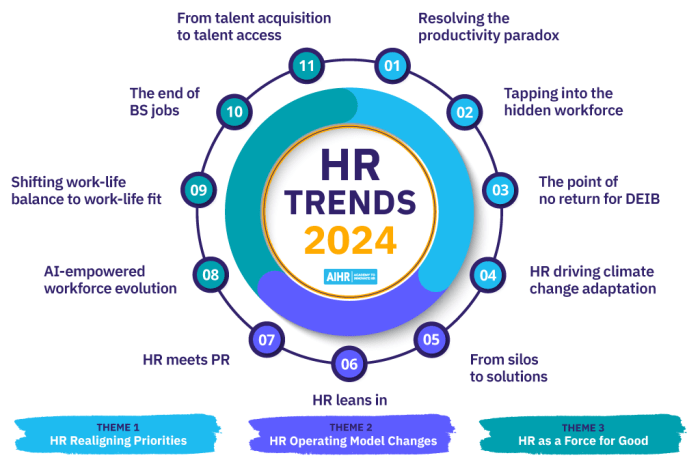
The rapid advancement of technology, particularly Artificial Intelligence (AI) and automation, is significantly reshaping the employment landscape in 2024. This transformative influence necessitates a proactive approach to understanding its implications and developing strategies to mitigate potential negative consequences for workers. While technological progress undoubtedly offers opportunities for increased productivity and economic growth, it also presents challenges that require careful consideration and strategic planning.The integration of AI and automation is already impacting various sectors, leading to both job creation and displacement.
Understanding these dual effects is crucial for navigating the evolving job market.
Influence of AI and Automation on the Job Market
The influence of AI and automation on the job market in 2024 is multifaceted. Several key aspects need to be considered:
- Automation of Routine Tasks: AI and automation are increasingly capable of performing repetitive, manual tasks previously handled by human workers. This affects roles in manufacturing, logistics, and data entry, among others. For example, automated warehouse systems are reducing the need for human order pickers and packers.
- Increased Efficiency and Productivity: The implementation of AI-powered tools and automated systems leads to significant gains in efficiency and productivity across various industries. This can result in increased output with fewer human resources, potentially leading to workforce reductions in certain areas.
- Creation of New Job Roles: While some jobs are displaced, the technological revolution also generates new roles requiring specialized skills in areas like AI development, data science, and cybersecurity. The demand for professionals who can manage, maintain, and develop these technologies is rapidly growing.
- Transformation of Existing Roles: Many existing job roles are being transformed rather than entirely eliminated. For example, the role of a radiologist is evolving to incorporate AI-assisted image analysis, requiring radiologists to develop skills in interpreting AI-generated insights.
Displacement of Workers and Mitigation Strategies
Technological advancements inevitably lead to the displacement of some workers. However, proactive strategies can help mitigate job losses and facilitate a smoother transition for affected individuals:
- Reskilling and Upskilling Initiatives: Governments and organizations must invest heavily in reskilling and upskilling programs to equip workers with the skills needed for the jobs of the future. This includes training in areas like data analysis, coding, and digital literacy.
- Investing in Education and Training: Early investment in education and training programs, focusing on STEM fields and digital skills, is crucial for preparing future generations for the changing job market. This needs to be a collaborative effort between educational institutions, businesses, and government.
- Social Safety Nets: Robust social safety nets, including unemployment benefits and retraining programs, are vital to support workers displaced by automation. These programs need to be adaptable and responsive to the evolving needs of the workforce.
- Promoting Entrepreneurship: Encouraging entrepreneurship and the creation of new businesses can generate employment opportunities and help absorb displaced workers. Support for startups and small businesses through funding and mentorship is crucial.
Adaptation of the Transportation Industry to Technological Change
Consider the transportation industry. The rise of autonomous vehicles presents a significant challenge to traditional trucking and taxi services. However, the industry is adapting in several ways:
Instead of simply resisting change, forward-thinking companies are integrating AI and automation strategically. For example, trucking companies are exploring the use of autonomous trucks for long-haul routes, freeing up human drivers for shorter, more complex routes requiring human interaction and decision-making. This approach retains human drivers in valuable roles while increasing efficiency through automation where feasible. Similarly, ride-sharing companies are investing in the development of autonomous vehicles while also focusing on expanding their services into new areas like delivery and logistics, creating new job opportunities for drivers in these related sectors.
The transition is not without its challenges, but a proactive, adaptable approach allows the industry to leverage technology while mitigating potential job displacement.
Remote Work and the Future of the Workplace
The rise of remote work accelerated dramatically in recent years, and 2024 sees it firmly entrenched as a significant aspect of the modern workplace. This shift has profoundly impacted various industries, leading to new challenges and opportunities for businesses and employees alike. Understanding the prevalence, benefits, and drawbacks of remote work is crucial for navigating the evolving employment landscape.
The impact of remote work extends beyond simply where employees perform their tasks. It significantly influences company culture, communication strategies, and overall productivity. The integration of hybrid models, combining both remote and in-office work, further complicates this dynamic, requiring organizations to adopt innovative management techniques.
Prevalence of Remote Work Across Industries
The percentage of remote workers varies considerably across different sectors. While precise figures fluctuate based on ongoing surveys and company-specific policies, a general trend toward increased remote work is undeniable. The following table provides a snapshot of the situation, recognizing that these are estimates based on available data and may vary depending on the source and methodology.
| Industry | Percentage of Remote Workers (Estimate) | Benefits of Remote Work | Challenges of Remote Work |
|---|---|---|---|
| Technology | 40-50% | Increased flexibility, access to a wider talent pool, reduced overhead costs | Maintaining team cohesion, potential for isolation, cybersecurity risks |
| Finance | 25-35% | Improved work-life balance, cost savings on office space, enhanced employee retention | Difficulties in collaboration, data security concerns, potential for burnout |
| Healthcare | 15-25% | Flexibility for healthcare professionals, reduced commute time, potential for increased patient access (in certain roles) | Maintaining patient confidentiality, reliance on technology infrastructure, regulatory compliance |
| Education | 30-40% | Increased flexibility for educators, potential for reaching wider student populations, cost savings | Maintaining student engagement, managing technology challenges, ensuring equitable access to resources |
Impact of Hybrid Work Models on Employee Productivity and Well-being
Hybrid work models, combining remote and in-office work, offer a middle ground. Studies on the impact of hybrid work on productivity and well-being show mixed results. While some studies suggest that hybrid models can enhance productivity and employee satisfaction by offering flexibility and improved work-life balance, others highlight challenges such as difficulties in communication and collaboration, blurring the lines between work and personal life, and potential for inequities among employees.
The overall success of a hybrid model depends heavily on effective implementation and a clear understanding of the needs of both the employees and the organization. For instance, companies like Spotify have successfully implemented hybrid models by focusing on team autonomy and flexible scheduling.
Successful Strategies for Managing Remote and Hybrid Teams
Effective management of remote and hybrid teams requires a strategic approach focusing on communication, technology, and culture. Several strategies have proven successful:
Firstly, clear communication channels and protocols are essential. This includes regular virtual meetings, instant messaging platforms, and project management tools to ensure everyone stays informed and connected. Secondly, investment in robust technology infrastructure is crucial. This includes reliable video conferencing systems, secure cloud storage, and collaborative workspaces to facilitate seamless communication and collaboration. Finally, fostering a strong company culture is vital, even in a remote or hybrid setting.
This can be achieved through regular virtual social events, team-building activities, and open communication to maintain a sense of community and belonging.
Examples of successful strategies include the use of project management software like Asana or Trello to track progress and deadlines, regular check-ins with individual team members to address concerns and provide support, and the creation of virtual social spaces to encourage informal interaction and team bonding. Companies like Google and Microsoft have invested heavily in internal communication platforms and tools to support their remote and hybrid workforce.
Skills and Education for Future Employment
Navigating the evolving job market of 2024 and beyond requires a strategic approach to skills development and education. The rapid pace of technological advancement and shifting industry demands necessitate a focus on both technical proficiency and adaptable soft skills. Lifelong learning is no longer a desirable trait; it’s a necessity for sustained career success.
The intersection of technological disruption and evolving workforce needs highlights the crucial role of education in preparing individuals for the future of work. Adaptability, continuous learning, and the acquisition of both hard and soft skills are paramount. Educational institutions must play a pivotal role in bridging the gap between academic learning and the practical demands of modern workplaces.
In-Demand Skills for the 2024 Job Market
The skills required to thrive in the 2024 job market can be broadly categorized into soft skills and technical skills. Both are equally vital for career success, complementing each other to create a well-rounded and competitive professional profile.
- Soft Skills: These transferable skills are applicable across various industries and roles. Examples include critical thinking, problem-solving, communication (written and verbal), teamwork, adaptability, time management, and leadership.
- Technical Skills: These skills are specific to particular industries and roles. High demand exists for skills in data analysis, artificial intelligence (AI), machine learning (ML), cybersecurity, cloud computing, software development (including specific languages like Python and Java), digital marketing, and project management software (like Jira and Asana).
The Role of Lifelong Learning and Upskilling/Reskilling
The dynamic nature of the modern workplace necessitates continuous learning and adaptation. Lifelong learning is no longer a luxury but a requirement for remaining competitive. Upskilling involves acquiring new skills to enhance existing capabilities, while reskilling involves gaining entirely new skills to transition to a different career path. Many online platforms, boot camps, and professional development programs offer opportunities for upskilling and reskilling.
For example, a marketing professional might upskill in digital marketing, while a manufacturing worker might reskill as a software developer.
Preparing Students for the Future Workforce
Educational institutions can significantly enhance their curriculum to better prepare students for the future workforce. This requires a shift towards more practical, hands-on learning and a focus on developing crucial soft skills alongside technical expertise.
- Integrating Practical Projects and Case Studies: Incorporating real-world projects and case studies allows students to apply their knowledge and develop problem-solving skills. For instance, a business school could incorporate a project requiring students to develop a marketing strategy for a real company.
- Emphasis on Soft Skills Development: Curriculum should include dedicated modules focused on developing crucial soft skills like communication, teamwork, and critical thinking. Role-playing exercises, group projects, and presentations can help foster these skills.
- Incorporating Emerging Technologies: Educational programs should incorporate training in emerging technologies like AI, machine learning, and data analytics, ensuring students are equipped with the skills demanded by future employers. For example, computer science programs could introduce AI ethics and responsible AI development.
- Promoting Interdisciplinary Learning: Encouraging collaboration between different departments and fostering interdisciplinary projects can help students develop a broader perspective and adaptability. For instance, a project involving engineering, design, and business students could simulate the development and launch of a new product.
EMPLOYMENT AND WORK
The nature of work is undergoing a profound transformation, driven by technological advancements, globalization, and evolving employee expectations. This shift necessitates a re-evaluation of the traditional employer-employee relationship, impacting everything from work styles and expectations to compensation and job security. Understanding these changes is crucial for both employers and employees to navigate the evolving landscape successfully.The relationship between employers and employees is becoming increasingly fluid and collaborative.
The rise of the gig economy and remote work options have blurred the lines of traditional employment models, leading to a greater emphasis on project-based work and flexible arrangements. This necessitates a shift in how employers manage talent, focusing on outcomes and performance rather than solely on hours worked or physical presence. Simultaneously, employees are demanding greater autonomy and control over their work schedules and environments.
Evolving Employee Expectations and Employment Trends
Employee expectations are significantly influencing employment trends. Work-life balance is no longer a desirable perk; it’s a fundamental requirement for many job seekers. This is reflected in the increasing demand for flexible working arrangements, generous parental leave policies, and opportunities for professional development that allow for a healthy integration of personal and professional life. Job security, once a cornerstone of the employer-employee relationship, is also evolving.
The increasing prevalence of contract work and the volatility of certain industries have led employees to prioritize skills development and adaptability to enhance their employability. Finally, compensation is a key driver of employment decisions, with employees seeking not only competitive salaries but also comprehensive benefits packages that reflect the value they bring to an organization. This includes health insurance, retirement plans, and opportunities for professional growth.
The modern employer-employee relationship is characterized by a shift from a transactional to a relational model, emphasizing mutual respect, collaboration, and shared goals. Successful organizations are those that prioritize employee well-being, invest in their development, and offer competitive compensation and benefits packages. The ability to adapt to evolving employee expectations is critical for attracting and retaining top talent in today’s competitive job market.
In conclusion, the employment landscape of 2024 is characterized by significant transformation driven by technological advancements, evolving work models, and changing employee expectations. Navigating this evolving landscape requires adaptability, continuous learning, and a proactive approach to skill development. By understanding the key trends discussed – from the rise of high-demand sectors to the challenges and opportunities presented by remote work and the gig economy – individuals and organizations can better position themselves for success in this dynamic and ever-changing environment.
The future of work is not merely about adapting to change; it’s about shaping it.
Questions and Answers
What are the biggest challenges facing employers in 2024?
Attracting and retaining top talent, adapting to technological advancements, managing remote and hybrid workforces, and ensuring employee well-being are significant challenges.
How can I make myself more competitive in the job market?
Focus on developing in-demand technical skills, enhancing your soft skills (communication, teamwork, problem-solving), and pursuing continuous learning and upskilling opportunities.
Is remote work here to stay?
While the prevalence of fully remote work may vary across industries, hybrid and flexible work models are expected to remain prominent, offering employees greater work-life balance and employers access to a wider talent pool.
What is the impact of AI on different job sectors?
AI’s impact varies widely. Some sectors will experience job displacement, while others will see new roles created requiring skills in AI development, implementation, and management. Reskilling and upskilling are crucial for navigating this change.


