
The modern workplace presents a complex tapestry of challenges, woven from threads of technological disruption, economic volatility, and evolving societal expectations. Understanding these employment challenges is crucial for both individuals seeking fulfilling careers and organizations striving for sustained success. This exploration delves into the multifaceted nature of these challenges, examining their historical context, current impact, and potential future trajectories.
From the displacement of workers by automation to the ever-widening skills gap, we will analyze the key factors shaping the employment landscape. We’ll also investigate the importance of work-life balance, diversity and inclusion, and the crucial role of proactive strategies in mitigating these challenges and fostering a more equitable and sustainable future of work.
Defining Employment Challenges
Employment challenges represent a complex interplay of factors affecting individuals seeking work, businesses employing them, and the broader societal landscape. Understanding these challenges requires a multifaceted perspective, considering economic realities, social structures, and technological advancements. This examination will delve into the definition, historical evolution, and categorization of these pervasive issues.
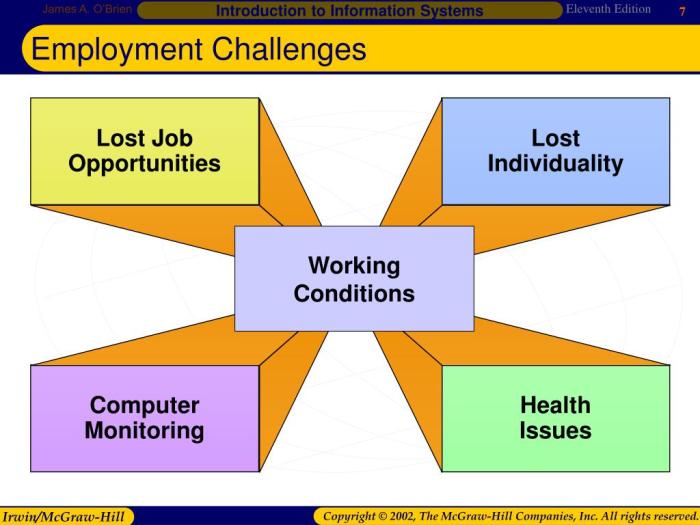
Employment challenges encompass a wide range of difficulties faced by employees, employers, and society as a whole. For employees, these challenges might include finding suitable employment, negotiating fair wages and benefits, maintaining work-life balance, and navigating career progression. Employers face challenges in recruiting and retaining talent, managing employee performance, adapting to changing economic conditions, and complying with labor laws. From a societal perspective, employment challenges manifest as unemployment, underemployment, income inequality, and skill gaps that hinder economic growth and social stability.
These challenges are not static; they evolve over time, influenced by broader economic trends, technological innovation, and shifts in social values.
Historical Evolution of Employment Challenges
Throughout history, the nature of employment challenges has undergone significant transformations. In the pre-industrial era, the primary challenges revolved around subsistence farming and localized employment opportunities. The Industrial Revolution brought about new challenges, including factory working conditions, child labor, and the rise of labor movements advocating for better wages and working conditions. The 20th century witnessed the emergence of new challenges related to automation, globalization, and the rise of the service sector.
More recently, the digital revolution has presented challenges related to the gig economy, remote work, and the need for continuous upskilling and reskilling to remain competitive in the job market. Each era has presented unique sets of obstacles, requiring different approaches to address them effectively. For instance, the rise of automation in manufacturing has led to job displacement in some sectors, necessitating retraining initiatives and the development of new job roles.
Categorization of Employment Challenges
A useful framework for understanding employment challenges involves categorizing them by type. This allows for a more systematic analysis and targeted approach to solutions. One such categorization system could include:
This categorization is not mutually exclusive; many challenges fall under multiple categories. For example, the rise of artificial intelligence (AI) can be considered a technological challenge that also has significant economic and social implications, potentially leading to job displacement and requiring workforce adaptation.
| Category | Description | Examples |
|---|---|---|
| Economic Challenges | Challenges stemming from economic downturns, inflation, wage stagnation, and income inequality. | Unemployment, underemployment, low wages, the gender pay gap. |
| Social Challenges | Challenges related to social inequalities, discrimination, and lack of access to education and training. | Ageism in the workplace, gender discrimination, racial bias in hiring. |
| Technological Challenges | Challenges arising from technological advancements, automation, and the changing nature of work. | Job displacement due to automation, the need for continuous upskilling, cybersecurity threats. |
| Legal and Regulatory Challenges | Challenges related to labor laws, compliance, and ethical considerations. | Workplace safety regulations, data privacy laws, compliance with anti-discrimination laws. |
Economic Factors Affecting Employment
Economic cycles significantly influence employment levels. Understanding this relationship is crucial for policymakers and businesses alike, as it allows for proactive strategies to mitigate the negative impacts of downturns and capitalize on periods of growth. The interplay between economic conditions and job markets is complex, involving various interconnected factors.The relationship between economic cycles and employment rates is fundamentally inverse.
During economic booms, characterized by high consumer spending, increased investment, and overall economic growth, employment rates typically rise. Businesses expand, creating new jobs to meet increased demand. Conversely, during recessions, marked by decreased economic activity, rising unemployment is a common consequence. Reduced consumer spending leads to decreased production, forcing businesses to cut costs, often through layoffs and hiring freezes.
The severity of these fluctuations varies depending on the length and depth of the economic cycle. For instance, the Great Recession of 2008-2009 saw a significant spike in unemployment across many developed nations, lasting several years before recovery began.
The Impact of Different Economic Policies on Employment
Economic policies play a critical role in shaping employment outcomes. Fiscal policies, which involve government spending and taxation, can stimulate economic activity during recessions. For example, increased government spending on infrastructure projects can create jobs directly in construction and related industries, and indirectly through increased consumer spending as a result of the employment created. Conversely, expansionary monetary policies, implemented by central banks, involve lowering interest rates to encourage borrowing and investment.
Lower interest rates make it cheaper for businesses to borrow money for expansion, leading to increased hiring. However, overly expansionary policies can lead to inflation, potentially negating the positive effects on employment. Conversely, contractionary fiscal and monetary policies, aimed at controlling inflation, may lead to reduced job creation and potentially increased unemployment in the short term. The effectiveness of these policies depends on various factors, including the specific economic context and the timing and implementation of the policies.
The 2020 COVID-19 pandemic saw governments globally implement large-scale fiscal stimulus packages, including direct cash payments to individuals and businesses, aiming to support employment and prevent widespread job losses. While the impact is still being assessed, these measures were intended to mitigate the economic downturn and its effects on employment.
Globalization and International Trade’s Effect on Domestic Employment
Globalization and international trade have profoundly impacted domestic employment levels. While increased trade can lead to greater economic efficiency and lower prices for consumers, it can also result in job displacement in certain sectors. For example, the rise of manufacturing in countries with lower labor costs has led to the decline of manufacturing jobs in many developed nations. This shift necessitates workforce adaptation and retraining initiatives to equip workers with the skills needed for emerging industries.
However, globalization also creates new opportunities. Increased international trade can lead to the growth of export-oriented industries, creating jobs in areas such as logistics, transportation, and international business. The net effect of globalization on domestic employment is complex and depends on various factors, including the specific industries affected, the ability of workers to adapt to changing job markets, and the government policies in place to mitigate negative impacts.
The North American Free Trade Agreement (NAFTA), later replaced by the United States-Mexico-Canada Agreement (USMCA), is a prominent example illustrating the complex impact of international trade agreements on domestic employment. While some sectors experienced job losses, others saw significant growth, leading to a mixed overall impact on employment levels.
Employment and Work
Fostering diversity and inclusion within the workplace is no longer a mere aspiration; it’s a critical business imperative. A diverse workforce brings a wider range of perspectives, skills, and experiences, leading to increased innovation, improved problem-solving, and enhanced creativity. Conversely, a lack of diversity and inclusion can stifle growth and negatively impact the bottom line.Creating a truly inclusive workplace requires a multifaceted approach, extending beyond simply hiring individuals from diverse backgrounds.
It demands a conscious effort to build a culture of respect, understanding, and equity where every employee feels valued and empowered to contribute their unique talents.
Challenges and Benefits of Diversity and Inclusion
The benefits of a diverse and inclusive workforce are significant and well-documented. Studies consistently show a strong correlation between diversity and improved financial performance. Companies with diverse leadership teams often experience higher profitability and return on equity. Moreover, a diverse workforce is better equipped to understand and serve a diverse customer base, leading to increased market share and brand loyalty.
However, the path to achieving true diversity and inclusion is not without its challenges. Overcoming unconscious bias in hiring and promotion processes, addressing systemic inequalities, and fostering a culture of psychological safety where employees feel comfortable expressing their opinions and concerns, are just some of the hurdles that organizations must navigate. Effective communication and training programs are crucial in overcoming these challenges.
Strategies for Creating an Inclusive Work Environment
Creating an inclusive work environment requires a proactive and comprehensive strategy. This includes implementing robust diversity and inclusion policies, providing diversity and inclusion training for all employees, and establishing employee resource groups (ERGs) that provide support and networking opportunities for employees from underrepresented groups. Furthermore, leadership commitment is paramount. Leaders must actively champion diversity and inclusion initiatives and hold themselves and their teams accountable for creating an inclusive culture.
Regularly reviewing and updating diversity and inclusion metrics, and ensuring fair and equitable compensation and benefits practices, are also critical components of a successful strategy. Transparent communication about diversity and inclusion goals and progress is also essential to build trust and foster a sense of shared responsibility.
Impact of Discriminatory Practices on Employee Morale and Productivity
Discriminatory practices, whether intentional or unintentional, can have a devastating impact on employee morale and productivity. When employees feel undervalued, disrespected, or unfairly treated, their job satisfaction plummets, leading to decreased motivation, reduced productivity, and increased absenteeism and turnover. A hostile work environment, characterized by harassment or discrimination, can create significant stress and anxiety, negatively affecting employees’ physical and mental health.
This not only impacts individual employees but also damages the overall organizational culture and reputation. The costs associated with high employee turnover, legal challenges, and reputational damage can be substantial. For example, a company facing a discrimination lawsuit might experience significant financial losses and reputational damage, impacting its ability to attract and retain talent.
Future Trends in Employment
The future of work is rapidly evolving, driven by technological advancements, globalization, and shifting societal values. Understanding these trends is crucial for individuals, businesses, and policymakers to navigate the coming challenges and opportunities effectively. Failing to adapt to these changes could lead to significant economic and social disruptions.Predicting the future is inherently uncertain, but analyzing current trends allows us to anticipate potential challenges and develop proactive solutions.
This section will explore likely future employment challenges, propose solutions, and visualize a potential evolution of the job market over the next decade.
Potential Future Employment Challenges
Several significant challenges are anticipated in the coming years. Automation and artificial intelligence (AI) are poised to transform many industries, potentially displacing workers in roles susceptible to automation. The gig economy, while offering flexibility, also presents challenges regarding job security, benefits, and worker rights. Furthermore, the skills gap—the mismatch between the skills possessed by the workforce and the skills demanded by employers—will likely widen, leading to unemployment and underemployment.
Finally, climate change and environmental concerns are increasingly shaping employment landscapes, requiring adaptation and the creation of new “green” jobs. For example, the rise of electric vehicles necessitates a workforce skilled in their manufacturing and maintenance, while simultaneously potentially displacing workers in the traditional combustion engine sector.
Solutions to Address Anticipated Future Employment Challenges
Addressing these challenges requires a multi-faceted approach. Investing in education and training programs focused on emerging technologies and in-demand skills is crucial. This includes reskilling and upskilling initiatives to help displaced workers transition to new roles. Promoting lifelong learning and adaptability will become increasingly vital. Furthermore, policy changes are needed to address the challenges of the gig economy, ensuring fair wages, benefits, and worker protections.
Finally, investing in sustainable industries and creating green jobs can mitigate the negative impacts of climate change while simultaneously creating new employment opportunities. The implementation of robust social safety nets, such as unemployment benefits and retraining programs, will be critical in supporting those affected by job displacement.
Predicted Evolution of the Job Market in the Next Decade: A Visual Representation
Imagine a dynamic chart, with the horizontal axis representing time (the next ten years) and the vertical axis representing job sectors. Several lines represent different job sectors, each showing its growth or decline over the decade. Some sectors, such as technology (AI, software development, data science), healthcare, and renewable energy, would show steep upward trends, reflecting significant job growth.
Other sectors, such as manufacturing (in some areas), traditional retail, and certain administrative roles, might show a downward or plateauing trend, reflecting potential job displacement due to automation. The chart would also illustrate the emergence of new job sectors related to sustainability, AI ethics, and cybersecurity. The overall picture would be one of significant transformation, with some sectors shrinking while others expand dramatically, emphasizing the need for workforce adaptation and reskilling.
The color coding of the lines could represent different levels of required skill sets (e.g., low-skill, mid-skill, high-skill) to further highlight the changing skill demands within the evolving job market. The chart’s title could be “Transformation of the Job Market: 2024-2034.” This visual representation would clearly show the shifting landscape and the need for proactive measures to manage the transition.
Successfully navigating the multifaceted challenges of the modern employment landscape requires a proactive and multifaceted approach. By understanding the interplay of technological advancements, economic fluctuations, and evolving societal values, individuals and organizations can better prepare for the future of work. Embracing adaptability, fostering continuous learning, and prioritizing employee well-being are key elements in building a more resilient and equitable workplace for all.
FAQ Overview
What are some common strategies for dealing with job loss due to automation?
Retraining and upskilling are crucial. Focus on acquiring in-demand skills, such as data analysis or coding. Networking and exploring new career paths are also vital.
How can I improve my work-life balance?
Set clear boundaries between work and personal life, prioritize tasks effectively, utilize time management techniques, and communicate your needs openly with your employer.
What is the best way to address ageism in the workplace?
Promote a culture of mentorship and knowledge sharing, highlighting the value of experience. Implement anti-discrimination policies and provide training to address unconscious bias.


