
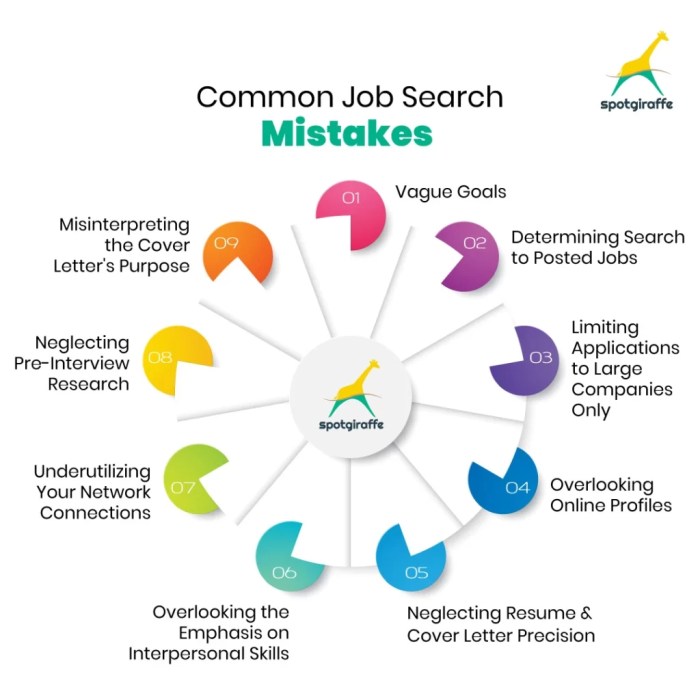
The job search can feel like navigating a treacherous landscape, filled with hidden pitfalls and unexpected challenges. Many job seekers unknowingly make common mistakes that significantly hinder their progress. Understanding these errors and learning how to avoid them is crucial for maximizing your chances of landing your dream job. This guide illuminates the most frequent missteps, offering practical strategies to improve your job search effectiveness and ultimately achieve your career goals.
From neglecting networking opportunities to submitting generic applications and overlooking the importance of a strong online presence, the path to employment is often paved with well-intentioned but ultimately ineffective approaches. This exploration delves into the key areas where job seekers often stumble, providing actionable advice and insightful examples to help you refine your strategy and significantly enhance your success rate.
Submitting Generic Resumes and Cover Letters
Submitting the same resume and cover letter for every job application is a common mistake that significantly reduces your chances of landing an interview. Recruiters and hiring managers can quickly spot generic applications, often discarding them without a second glance. This is because generic documents fail to demonstrate your genuine interest and suitability for the specific role and company.
A personalized approach is crucial for showcasing your skills and experience in the context of the particular job requirements.The importance of tailoring your application materials to each job description cannot be overstated. A customized resume and cover letter show that you’ve taken the time to understand the company and the specific role, demonstrating initiative and a genuine interest in the opportunity.
This targeted approach significantly increases your chances of standing out from the competition and securing an interview. By highlighting relevant skills and experiences that directly address the employer’s needs, you effectively position yourself as the ideal candidate.
Tailoring Resumes and Cover Letters for Different Roles
Customizing your resume and cover letter involves more than just changing the company name and contact information. It requires a thorough understanding of the job description and a strategic approach to highlighting your most relevant skills and experiences. For example, if applying for a marketing role emphasizing digital strategies, you would highlight your experience with , social media marketing, and analytics, rather than focusing on print advertising if that’s not specifically mentioned.
Conversely, for a traditional marketing role, emphasizing print media experience would be more appropriate.Consider these examples: A candidate applying for a data analyst position should lead with their proficiency in SQL, Python, and data visualization tools, showcasing projects that demonstrate their analytical skills and problem-solving abilities. In contrast, a candidate applying for a customer service representative role would highlight their communication skills, conflict resolution experience, and customer satisfaction metrics.
The key is to align your skills and experience with the specific requirements and responsibilities Artikeld in the job description.
A Step-by-Step Guide to Crafting Targeted Application Materials
- Thoroughly Review the Job Description: Carefully read and analyze the job description, paying close attention to s, required skills, and responsibilities. Identify the key requirements and competencies the employer is seeking.
- Research the Company: Learn about the company’s mission, values, culture, and recent activities. Understanding the company context allows you to tailor your application to their specific needs and demonstrate your understanding of their business.
- Identify Relevant Skills and Experiences: Match your skills and experiences to the specific requirements Artikeld in the job description. Select examples from your past work that directly demonstrate your ability to fulfill the responsibilities of the role.
- Customize Your Resume: Revise your resume to highlight the most relevant skills and experiences identified in the previous step. Use s from the job description to improve your resume’s searchability by Applicant Tracking Systems (ATS). Adjust the order of sections and bullet points to emphasize the most relevant information.
- Craft a Targeted Cover Letter: Write a cover letter that specifically addresses the requirements and responsibilities Artikeld in the job description. Show how your skills and experiences align with the company’s needs and the specific role. Begin by mentioning the specific position you’re applying for and how you learned about the opening. Weave in details about the company, showing you’ve done your research.
- Proofread Carefully: Before submitting your application, thoroughly proofread your resume and cover letter for any grammatical errors, typos, or inconsistencies. A well-written and error-free application demonstrates professionalism and attention to detail.
Neglecting Online Presence
In today’s digital age, your online presence is often the first impression you make on potential employers. A well-crafted online profile can significantly enhance your job search efforts, while a neglected or unprofessional one can seriously hinder your chances. Recruiters frequently use online platforms like LinkedIn to source candidates, making a strong online presence crucial for career advancement.A robust online presence demonstrates professionalism, showcases your skills and experience, and allows you to connect with industry professionals.
It’s no longer enough to simply submit a resume and cover letter; your digital footprint plays a vital role in the modern job search process. Failing to cultivate a positive online presence leaves you at a significant disadvantage compared to candidates who actively manage their online profiles.
Common Mistakes in Online Profiles
Many job seekers inadvertently make mistakes that damage their online professional image. These errors can range from minor oversights to significant omissions that negatively impact their perceived suitability for a role. Addressing these common pitfalls is essential for optimizing your online presence.
- Incomplete or Inaccurate Profiles: Leaving key sections blank, such as experience summaries or skills endorsements, presents a lack of attention to detail. Similarly, inaccurate or outdated information can damage credibility.
- Poorly Written Profile Summaries: A generic or poorly written summary fails to capture attention and highlight your unique value proposition. It should be concise, compelling, and tailored to your target roles.
- Lack of Professional Headshot: A missing or unprofessional headshot conveys a lack of seriousness and can make you seem less approachable. A high-quality, professional headshot is crucial for making a strong first impression.
- Inadequate Networking: Failing to connect with colleagues, mentors, and recruiters limits your exposure and networking opportunities. Actively engaging with your network is vital for staying informed about job opportunities and building relationships.
- Ignoring Recommendations/Endorsements: Recommendations and endorsements from colleagues and supervisors add credibility and social proof to your profile, validating your skills and experience. Actively seeking these is a valuable strategy.
- Privacy Settings: Overly restrictive privacy settings can hinder recruiters from finding you. Carefully consider your privacy settings while ensuring your profile is discoverable to relevant professionals.
Strategies for Optimizing Online Profiles
Optimizing your online presence involves proactive steps to enhance your profile’s visibility and appeal to recruiters. By focusing on these key areas, you can significantly improve your chances of landing your dream job.
- Optimization: Incorporate relevant s from job descriptions into your profile summary, experience descriptions, and skills sections. This improves search engine optimization () and makes your profile more discoverable.
- Compelling Narrative: Craft a compelling narrative that showcases your achievements, skills, and career aspirations. Use action verbs and quantifiable results to demonstrate your impact in previous roles.
- Professional Headshot and Banner Image: Invest in a professional headshot and consider a visually appealing banner image that reflects your personality and professional brand. This enhances your profile’s visual appeal and creates a memorable first impression.
- Active Networking: Engage with your network by commenting on posts, participating in discussions, and connecting with recruiters and professionals in your field. This builds relationships and increases your visibility.
- Regular Updates: Keep your profile up-to-date with your latest achievements, skills, and experiences. Regular updates demonstrate that you are actively engaged in your career development.
Checklist for Reviewing and Improving Online Presence
Before submitting your application for any role, it’s crucial to review and refine your online presence. Use this checklist to ensure your profile is optimized for success.
- Profile Completeness: Ensure all sections are completed accurately and comprehensively.
- Summary Quality: Review your summary for clarity, conciseness, and impact.
- Headshot Professionalism: Verify that your headshot is professional and up-to-date.
- Network Engagement: Assess your network activity and identify opportunities for further engagement.
- Optimization: Check for relevant s and ensure your profile is easily searchable.
- Privacy Settings: Review your privacy settings to ensure optimal discoverability while maintaining privacy.
- Recommendation/Endorsements: Seek out recommendations and endorsements from colleagues and supervisors.
- Recent Updates: Ensure your profile reflects your current skills and experience.
Poor Communication Skills
Effective communication is paramount to a successful job search. From crafting a compelling resume and cover letter to acing the interview, your ability to clearly and concisely convey your skills and experience directly impacts your chances of landing the job. Poor communication, conversely, can quickly derail your efforts, leaving a negative impression and hindering your progress.Poor communication skills significantly impact a job seeker’s success by creating misunderstandings, misrepresenting qualifications, and ultimately, reducing their appeal to potential employers.
A poorly written resume or cover letter can be immediately discarded, while hesitant or unclear answers during an interview can lead to a missed opportunity. The inability to articulate thoughts effectively signals a lack of professionalism and can raise concerns about the candidate’s ability to perform the job effectively. Conversely, strong communication skills showcase confidence, competence, and the ability to build rapport, all essential attributes employers seek.
Effective and Ineffective Communication Styles During Interviews
Effective communication during interviews involves clear, concise, and confident articulation of thoughts and experiences. It involves active listening, engaging in thoughtful responses, and demonstrating genuine enthusiasm. Ineffective communication, on the other hand, is characterized by rambling, vague answers, and a lack of engagement with the interviewer. It might involve using excessive jargon, interrupting the interviewer, or failing to answer the question directly.
A successful candidate demonstrates both verbal and non-verbal cues indicating attentiveness and professionalism. For example, maintaining eye contact, using appropriate body language, and speaking clearly and confidently all contribute to a positive impression. Conversely, fidgeting, avoiding eye contact, or speaking too softly or quickly can convey nervousness and lack of confidence.
Examples of Strong and Weak Answers to Common Interview Questions
Strong answers to common interview questions are typically concise, focused, and provide specific examples to illustrate the candidate’s skills and experience. For instance, when asked about a time they failed, a strong answer might describe a specific situation, the steps taken to address the failure, and the lessons learned. A weak answer, in contrast, would be vague, generic, or fail to provide any concrete examples.
For example, instead of saying “I’m a team player,” a strong answer might describe a specific team project and the candidate’s contribution to its success. Instead of simply stating strengths, a strong answer would use the STAR method (Situation, Task, Action, Result) to provide a concrete example illustrating the strength.
Improving Nonverbal Communication During Job Interviews
Nonverbal communication plays a crucial role in how an interviewer perceives a candidate. Improving nonverbal communication involves practicing good posture, maintaining eye contact, and using appropriate hand gestures. Smiling genuinely, nodding to show understanding, and leaning slightly forward to demonstrate engagement are all positive nonverbal cues. Conversely, slouching, avoiding eye contact, fidgeting, or crossing arms can project negativity and lack of confidence.
Practicing in front of a mirror or with a friend can help candidates become more aware of their body language and refine their nonverbal communication skills. Mirroring the interviewer’s body language subtly (while remaining natural) can help build rapport and establish a connection.
Unrealistic Job Expectations
Entering the job market with unrealistic expectations can significantly hinder your search. A mismatch between your desired compensation, benefits, and career trajectory with the realities of the job market can lead to prolonged unemployment and frustration. Understanding and managing these expectations is crucial for a successful job search.One of the most common pitfalls is holding unrealistic salary expectations.
This can stem from overestimating your worth based on limited experience or inflated self-perception, or from failing to account for market realities. Setting a realistic salary expectation is essential for attracting suitable job offers and progressing efficiently in your job search.
Factors Influencing Realistic Salary Expectations
Several factors influence what constitutes a realistic salary expectation. These include your education level, years of experience, specific skills and expertise, geographic location, industry, and the size and type of company. For instance, a software engineer with ten years of experience in Silicon Valley will likely command a higher salary than a recent graduate with the same degree working in a smaller city.
Similarly, a marketing role at a Fortune 500 company will typically offer higher compensation than a similar role at a smaller startup. Considering these variables is crucial when assessing your own earning potential.
Researching Industry Salary Ranges
Thorough research is key to forming realistic salary expectations. Several online resources provide salary data, including sites like Glassdoor, Salary.com, Payscale, and LinkedIn Salary. These platforms allow you to filter by job title, location, experience level, and company size to obtain a range of typical salaries for your target positions. It’s important to consult multiple sources to get a comprehensive picture and to avoid relying on a single, potentially skewed, data point.
Networking with professionals in your field can also provide valuable insights into compensation expectations.
Negotiating Salary Effectively
Once you’ve identified a realistic salary range, you need to be prepared to negotiate effectively. Begin by researching the average salary for the position in your area and the specific company. Knowing your worth and having data to support your claims will give you confidence during the negotiation process. It’s advisable to present your salary requirements as a range, rather than a fixed number, to allow for flexibility and negotiation.
Focus on your skills and experience, emphasizing your value to the company, rather than solely focusing on your desired salary. Remember that negotiation is a two-way street; be prepared to discuss your expectations for benefits, professional development opportunities, and other aspects of the role alongside salary. A well-structured and confident approach will increase your chances of securing a favorable compensation package.
Lack of Research on Companies and Roles
Applying for a job without thoroughly researching the company and the specific role is a significant misstep. It demonstrates a lack of preparation and genuine interest, potentially hindering your chances of securing an interview, let alone a job offer. A well-researched application showcases your initiative and understanding, making you a more compelling candidate.Understanding the company’s mission, values, recent projects, and overall culture is crucial.
This allows you to tailor your resume and cover letter to highlight experiences that directly align with their needs and demonstrate a genuine understanding of their work. Furthermore, researching the specific role enables you to articulate how your skills and experience directly address the responsibilities and requirements Artikeld in the job description. This targeted approach significantly improves your chances of standing out from other applicants.
Company Culture and Values Research
Gaining insight into a company’s culture and values provides a deeper understanding of the work environment and helps you assess whether it’s a good fit for you. This goes beyond simply reading the “About Us” section on their website. Consider exploring employee review sites like Glassdoor or Indeed to gain insights into employee experiences. Look for recurring themes in employee feedback, paying attention to comments on work-life balance, management style, and overall company atmosphere.
Analyzing the company’s social media presence, particularly LinkedIn and Twitter, can also provide valuable clues about their culture and values. For instance, observing the type of content they share, the tone of their communication, and the interactions they have with their followers can reveal aspects of their company personality. Examining press releases and news articles about the company can provide further context on their recent achievements, challenges, and public image, which can contribute to a more comprehensive understanding of their culture.
Effective Research Strategies
Effective research goes beyond a cursory glance at the company website. A comprehensive approach involves utilizing various resources to gather a holistic view. Start by thoroughly reviewing the company’s website, paying close attention to their “About Us,” “Mission,” and “Values” sections. Explore their newsroom or press releases for recent announcements and achievements. Utilize LinkedIn to research the company’s employees, particularly those in the role you’re applying for, to gain insight into their career paths and experiences.
Engage with their social media profiles to observe their communication style and gain a sense of their public image. Finally, consult review sites like Glassdoor and Indeed to get an understanding of the employee experience, although it’s crucial to approach such reviews with a critical eye, considering the potential for bias. Remember to cross-reference information from multiple sources to get a well-rounded picture.
Research Checklist
Before applying for any role, consider using this checklist to ensure thorough research:
- Company Website: Review “About Us,” “Mission,” “Values,” and recent news/press releases.
- LinkedIn: Research the company page and individual employees, particularly those in the target role.
- Social Media: Analyze company profiles on platforms like Twitter, Facebook, and Instagram.
- Review Sites: Consult Glassdoor, Indeed, and similar platforms for employee feedback (with critical evaluation).
- News Articles: Search for recent news articles about the company to understand current events and public perception.
- Job Description: Carefully review the job description to understand the key responsibilities and required skills.
- Competitor Analysis: Research the company’s main competitors to understand their market position and competitive landscape.
EMPLOYMENT AND WORK
Economic downturns significantly impact the job market, increasing competition and making job searching more challenging. However, with a strategic approach, job seekers can navigate these periods effectively and increase their chances of securing employment. Understanding the nuances of job searching during economic uncertainty is crucial for success.
Job searching during an economic downturn differs considerably from searching during a boom. In a booming economy, opportunities abound, and companies actively seek talent. The focus is often on securing the best candidate quickly. During a recession, however, companies become more cautious, reducing hiring and increasing scrutiny of applicants. The competition intensifies, and the job search process typically takes longer.
Successful strategies need to adapt to these shifts in the employment landscape.
Job Search Strategies During Economic Downturns
Effective job searching during economic downturns requires a multi-pronged approach that combines traditional methods with innovative strategies. It necessitates resilience, adaptability, and a proactive mindset.
- Network Extensively: Leverage your existing network and actively build new connections. Attend industry events (even virtual ones), reconnect with former colleagues, and utilize platforms like LinkedIn to expand your reach. Inform your contacts about your job search, emphasizing your skills and experience.
- Target Niche Industries: Research industries less affected by the downturn. Healthcare, education, and technology often experience less disruption than others. Focusing your efforts on these sectors can increase your chances of success.
- Consider Temporary or Contract Work: Temporary positions can provide valuable experience, income, and potential pathways to permanent employment. These roles often offer a foot in the door, allowing you to showcase your skills and build relationships within a company.
- Upskill or Reskill: Invest in improving your skills or learning new ones that are in high demand. Online courses, boot camps, and certifications can enhance your marketability and make you a more competitive candidate.
- Be Open to Geographic Relocation: If feasible, consider expanding your job search to include locations with more robust job markets. This may involve a temporary move or a more permanent relocation, depending on your circumstances.
Comparison of Job Search Methods During Economic Booms and Downturns
The following table compares and contrasts different job search strategies for periods of economic growth and recession.
| Strategy | Description | Effectiveness in Growth | Effectiveness in Recession |
|---|---|---|---|
| Online Job Boards | Using websites like Indeed, LinkedIn, etc. to find and apply for jobs. | High – Many open positions are advertised. | Moderate – Still useful, but more competition. |
| Networking | Leveraging personal and professional contacts to find opportunities. | High – Can lead to quick placement. | High – Crucial for finding hidden opportunities. |
| Direct Applications | Applying directly to companies even without advertised openings. | Moderate – Can be effective but requires more effort. | High – Companies may be less likely to advertise. |
| Recruiters | Working with recruitment agencies to find suitable roles. | High – Recruiters have access to many unadvertised jobs. | Moderate – Recruiters may have fewer roles, but still a valuable resource. |
| Freelancing/Gig Work | Taking on short-term projects or contract work. | Moderate – Good for supplemental income. | High – Can provide income and experience during a downturn. |
Resources Available to Job Seekers During Economic Hardship
Numerous resources are available to assist job seekers during economic hardship. These resources provide support, guidance, and opportunities to navigate the challenges of unemployment.
- Government Agencies: Many governments offer unemployment benefits, job training programs, and career counseling services. These services can provide financial assistance and support during the job search process.
- Non-profit Organizations: Numerous non-profit organizations provide job search assistance, resume writing workshops, and interview preparation. These organizations often cater to specific demographics or industries.
- Community Colleges and Universities: These institutions frequently offer career counseling, job placement services, and training programs to help individuals acquire new skills or enhance existing ones.
- Online Resources: Websites and platforms offer resources like resume templates, interview tips, and job search strategies. Many online courses provide opportunities for upskilling or reskilling.
Comprehensive Job Search Plan for Navigating an Economic Downturn
A successful job search during a downturn requires a structured approach. This plan combines elements of traditional and innovative job searching strategies.
- Assess Your Skills and Experience: Identify your transferable skills and highlight your strengths. Update your resume and cover letter to reflect your most relevant qualifications.
- Network Strategically: Reach out to your contacts, attend industry events, and actively engage on professional networking platforms. Inform people of your job search goals.
- Target Specific Industries: Research industries less affected by the economic downturn and focus your job search efforts on these sectors.
- Expand Your Search Radius: Consider relocating to areas with more job opportunities if feasible.
- Upskill or Reskill: Identify skills in high demand and invest in training or education to enhance your marketability.
- Explore Temporary or Contract Work: Consider temporary positions as a means to gain experience and build connections.
- Utilize All Available Resources: Leverage government agencies, non-profit organizations, and online resources to support your job search.
- Maintain a Positive Attitude: A positive attitude and persistence are crucial during a challenging job search. Celebrate small victories and remain focused on your goals.
Successfully navigating the job search requires a proactive and strategic approach. By avoiding common mistakes like neglecting networking, submitting generic applications, or failing to follow up effectively, you can dramatically increase your chances of landing your ideal role. Remember that a well-crafted resume and cover letter, a strong online presence, and effective communication skills are essential building blocks for a successful job search.
Continuous self-assessment and learning from feedback are crucial for long-term success in your career journey. Embrace these insights, refine your strategies, and confidently pursue your professional aspirations.
Top FAQs
What if I don’t have much networking experience?
Start small! Connect with former colleagues, professors, or even friends of friends. Attend industry events and online forums to meet people in your field.
How do I tailor my resume and cover letter effectively?
Carefully read the job description and highlight skills and experiences that directly align with the requirements. Use s from the job posting in your resume and cover letter.
What constitutes a strong online presence?
Ensure your LinkedIn profile is up-to-date and professional. Consider creating a portfolio website to showcase your work. Maintain a consistent and positive online persona across all platforms.
How can I improve my interview skills?
Practice answering common interview questions, research the company thoroughly, and prepare thoughtful questions to ask the interviewer. Focus on clear and concise communication, both verbal and non-verbal.
What if I’m unsure about my salary expectations?
Research industry salary ranges using online resources like Glassdoor or Salary.com. Consider your experience, skills, and location when setting your expectations.


