
The hybrid work model has rapidly reshaped the modern workplace, offering a compelling blend of in-office collaboration and remote flexibility. This approach, balancing the benefits of both traditional and remote work arrangements, presents a unique set of advantages and challenges for both employers and employees. Understanding the nuances of this model—from its various implementations to its impact on company culture and employee well-being—is crucial for navigating the evolving landscape of professional life.
This guide delves into the intricacies of hybrid work, examining its benefits, challenges, and technological underpinnings. We explore strategies for successful implementation, addressing key considerations in areas such as communication, performance management, and legal compliance. Ultimately, we aim to provide a clear and insightful perspective on the hybrid work model’s present and future implications.
Legal and HR Considerations for Hybrid Work
Successfully implementing a hybrid work model requires careful consideration of legal and HR implications to ensure compliance and maintain a productive and equitable work environment. Failing to address these aspects can lead to legal challenges, employee dissatisfaction, and decreased productivity. This section Artikels key legal and HR considerations for organizations transitioning to or already operating under a hybrid work model.
Employment Law Implications of Hybrid Work
Hybrid work arrangements introduce complexities to traditional employment law. For instance, issues surrounding worker classification (employee vs. independent contractor), minimum wage and overtime pay regulations, and workplace safety laws require careful navigation. Differing state and federal regulations must be considered, particularly regarding aspects like breaks, meal periods, and working hours. Companies must ensure that their hybrid work policies comply with all applicable laws, considering the location of employees and the nature of their work.
For example, an employee working from home in one state may be subject to different regulations than an employee working from a company office in another state. Clear policies defining work hours and expectations are crucial for managing these complexities and mitigating potential legal risks.
Data Privacy in Hybrid Work Environments
The shift to hybrid work significantly expands the potential for data breaches and privacy violations. Employees accessing company data from personal devices and home networks introduce new vulnerabilities. Organizations must implement robust data security measures, including strong password policies, multi-factor authentication, and employee training on data protection best practices. Compliance with data privacy regulations like GDPR (in Europe) and CCPA (in California) is paramount.
Regular audits and security assessments are vital to identify and address potential weaknesses. For instance, companies might require employees to use company-provided laptops and enforce the use of virtual private networks (VPNs) to secure access to company systems from remote locations.
Establishing Clear Policies and Procedures for Hybrid Employees
A well-defined policy framework is essential for managing a hybrid workforce effectively. This framework should cover various aspects, including work location expectations, communication protocols, equipment provision, and performance management. Clear guidelines on eligibility for hybrid work, the process for requesting hybrid arrangements, and the expectations for in-office and remote workdays are necessary. The policy should also Artikel procedures for addressing issues such as technology support, workplace safety (both in-office and at home), and conflict resolution.
For example, a company might establish a clear policy outlining the frequency of in-office days, the process for requesting exceptions, and the consequences of non-compliance.
Adjustments to HR Practices for Hybrid Work
HR practices must adapt to accommodate the unique needs of a hybrid workforce. Performance reviews need to shift from solely focusing on in-office presence to measuring outcomes and contributions regardless of location. Compensation structures might require adjustments to reflect the varying costs and benefits associated with remote and in-office work. Training and development programs need to be accessible and effective for both in-office and remote employees.
For example, a company might implement a system of regular check-ins with remote employees, using video conferencing and project management software to track progress and provide support. Additionally, performance reviews should incorporate feedback from both managers and peers, ensuring a holistic assessment of individual contributions.
Key Legal and HR Considerations for Hybrid Work: A Summary
- Compliance with all applicable employment laws, including those related to wages, hours, and workplace safety, considering the location of employees.
- Implementation of robust data security measures to protect sensitive company information accessed from various locations.
- Development of clear and comprehensive policies addressing work location, communication, equipment, performance management, and conflict resolution.
- Adaptation of HR practices, including performance reviews and compensation structures, to accommodate the unique needs of a hybrid workforce.
- Provision of adequate training and support to employees regarding data security, company policies, and the use of technology for remote work.
- Regular review and update of policies and procedures to reflect changes in legislation, technology, and best practices.
The Future of Hybrid Work
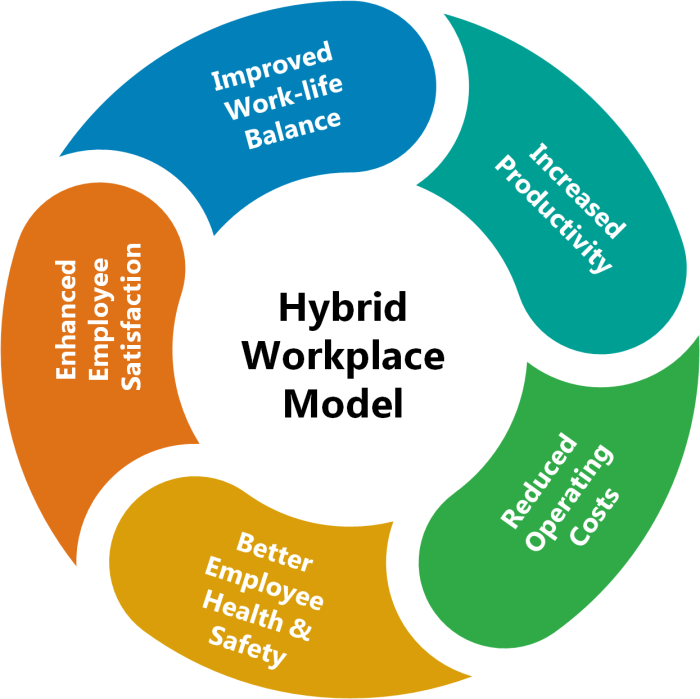
The hybrid work model, while still relatively new, is rapidly evolving. Its future trajectory will be shaped by technological advancements, shifting employee expectations, and evolving business needs. Understanding these forces is crucial for organizations aiming to remain competitive and attract top talent.Predicting the future is inherently uncertain, but analyzing current trends allows us to formulate plausible scenarios for the evolution of hybrid work.
Technological Advancements Shaping Hybrid Work
Technological advancements will play a pivotal role in refining and expanding the capabilities of hybrid work models. Improved video conferencing solutions with enhanced features like AI-powered noise cancellation and realistic avatars will create a more immersive and engaging remote collaboration experience. The rise of the Metaverse and virtual reality (VR) technologies could potentially revolutionize remote meetings and team-building activities, creating more engaging and interactive virtual workspaces.
Furthermore, advancements in automation and AI will free up employees from routine tasks, allowing them to focus on higher-value work regardless of their location. For example, companies like Zoom are continuously improving their video conferencing platform, while others are exploring the integration of VR and AR technologies for remote collaboration. The increasing sophistication of project management software and communication tools will also streamline workflows and enhance team coordination in hybrid environments.
Emerging Trends and Their Implications
Several emerging trends are reshaping the hybrid work landscape. One key trend is the increasing demand for flexible work arrangements, with employees prioritizing work-life balance and autonomy. This necessitates businesses to develop more adaptable policies and technologies to support flexible work schedules and remote work capabilities. Another significant trend is the rise of the “hybrid-first” approach, where companies design their operations and workplace around the hybrid model, rather than viewing it as an exception to traditional office work.
This shift reflects a growing acceptance of the long-term viability of hybrid work and the recognition of its benefits for both employers and employees. For instance, companies like Spotify and Google have adopted hybrid-first models, recognizing the need for both in-office collaboration and remote flexibility. Finally, the focus on employee well-being is becoming increasingly important, with companies investing in resources and programs to support the mental and physical health of their hybrid workforce.
Future Scenarios for Hybrid Work
Imagine three distinct future scenarios for hybrid work, each reflecting a different approach and technological landscape:Scenario 1: The “Smart Office” Scenario. This scenario depicts a highly technologically advanced workplace where the physical office acts as a central hub for collaboration and innovation. The office is equipped with advanced technologies such as holographic projectors, immersive VR meeting rooms, and AI-powered assistants to facilitate seamless communication and collaboration between remote and in-office employees.
This model emphasizes the strategic use of physical space for high-impact interactions and team-building activities, while leveraging technology to bridge the gap between remote and in-office teams.Scenario 2: The “Distributed Teams” Scenario. In this scenario, the traditional office plays a less central role, with teams spread across various geographical locations. Communication and collaboration rely heavily on advanced digital tools and platforms.
The focus is on creating a strong virtual culture and fostering a sense of community amongst geographically dispersed employees. This model may involve the use of virtual offices and collaborative platforms that allow teams to work seamlessly across different time zones and locations. Think of global software development teams already operating in this manner.Scenario 3: The “Fluid Workplace” Scenario. This scenario represents a more flexible and personalized approach to hybrid work, where employees have greater autonomy in choosing their work location and schedule based on their individual needs and project requirements.
The emphasis is on outcome-based work and trust, with technology enabling seamless communication and collaboration regardless of location. This model requires robust digital infrastructure and a culture of trust and accountability. Companies like Buffer, known for its remote-first culture, embody aspects of this model.
Hybrid Work and Employment and Work
The rise of the hybrid work model is fundamentally altering the traditional understanding of employment and work, moving away from the rigid structures of the 9-to-5 office environment. This shift impacts how work is defined, performed, and perceived, leading to a re-evaluation of employee roles, company culture, and the very nature of the employer-employee relationship.The hybrid model blends remote and in-office work, creating a flexible arrangement that affects various aspects of employment and work.
This flexibility, while offering numerous advantages, also presents unique challenges that need careful consideration.
Impact of Hybrid Work on Work Culture and Employee Expectations
Hybrid work significantly reshapes workplace culture. The traditional office environment, with its inherent social interactions and informal collaborations, is replaced by a more distributed and technology-mediated system. This necessitates a shift towards asynchronous communication, digital collaboration tools, and a stronger emphasis on clearly defined roles and responsibilities to maintain productivity and team cohesion. Employee expectations also evolve, with a greater emphasis on autonomy, flexibility, and a better work-life balance.
Companies adopting hybrid models often see increased employee satisfaction resulting from the perceived increase in control over their work schedules and locations. Conversely, challenges arise in maintaining a strong sense of company culture and fostering team bonding when employees are not physically co-located. Successful hybrid models often incorporate regular in-person team-building activities and social events to mitigate this.
Effects of Hybrid Work on Employee Well-being and Job Satisfaction
The impact of hybrid work on employee well-being and job satisfaction is multifaceted. While the flexibility afforded by hybrid work can reduce stress and improve work-life balance, leading to increased job satisfaction, it can also lead to feelings of isolation and burnout if not managed effectively. For example, the blurring of boundaries between work and personal life can lead to overwork, while inadequate communication and lack of social interaction can negatively affect mental health.
Companies need to actively support employee well-being through initiatives such as providing resources for mental health, promoting healthy work habits, and fostering a culture of open communication and support. Regular check-ins, both individual and team-based, are crucial to monitor employee well-being and address any concerns proactively.
Comparison of Hybrid Work with Other Contemporary Work Arrangements
The hybrid work model can be compared and contrasted with other contemporary work arrangements, such as fully remote work and traditional office-based work. Fully remote work offers maximum flexibility but can lead to greater isolation and challenges in team collaboration. Traditional office-based work provides strong social interaction and easy collaboration but often lacks flexibility and can lead to longer commutes and less autonomy.
Hybrid work attempts to strike a balance, offering flexibility while retaining some level of in-person interaction. The optimal arrangement depends on the specific nature of the work, the company culture, and individual employee preferences. For instance, roles requiring close collaboration or hands-on work might benefit from a more office-centric approach, while roles involving independent tasks might be better suited to a predominantly remote setup.
The key is to find a model that maximizes productivity, employee well-being, and company success.
The hybrid work model is not a one-size-fits-all solution, but rather a dynamic approach that requires careful planning and adaptation. Successful implementation hinges on clear communication, robust technology, and a commitment to fostering a strong and inclusive company culture. By addressing the challenges and leveraging the benefits, organizations can harness the power of hybrid work to enhance employee satisfaction, boost productivity, and gain a competitive edge in the modern marketplace.
The future of work is undeniably hybrid, and understanding its complexities is key to thriving in this new era.
FAQ Corner
What are the key differences between a hybrid and fully remote model?
A hybrid model involves a combination of in-office and remote work, while a fully remote model is entirely work-from-home based. Hybrid models often specify certain days in the office or offer flexible scheduling options, whereas fully remote work allows for complete location independence.
How can companies ensure fairness among employees in a hybrid work model?
Transparency and clear policies are paramount. Companies should establish consistent performance metrics, provide equal opportunities for advancement, and ensure equitable access to resources and training regardless of work location. Regular communication and feedback are also crucial.
What are some common pitfalls to avoid when implementing a hybrid work model?
Poor communication, inadequate technology, insufficient training, and a lack of clear policies and procedures are frequent stumbling blocks. Failing to address equity concerns among employees working in different locations can also create significant challenges.
How can a hybrid model improve employee retention?
By offering work-life balance, flexibility, and autonomy, hybrid models can significantly increase employee satisfaction and reduce burnout, leading to higher retention rates. A supportive and understanding management style is also essential.


